
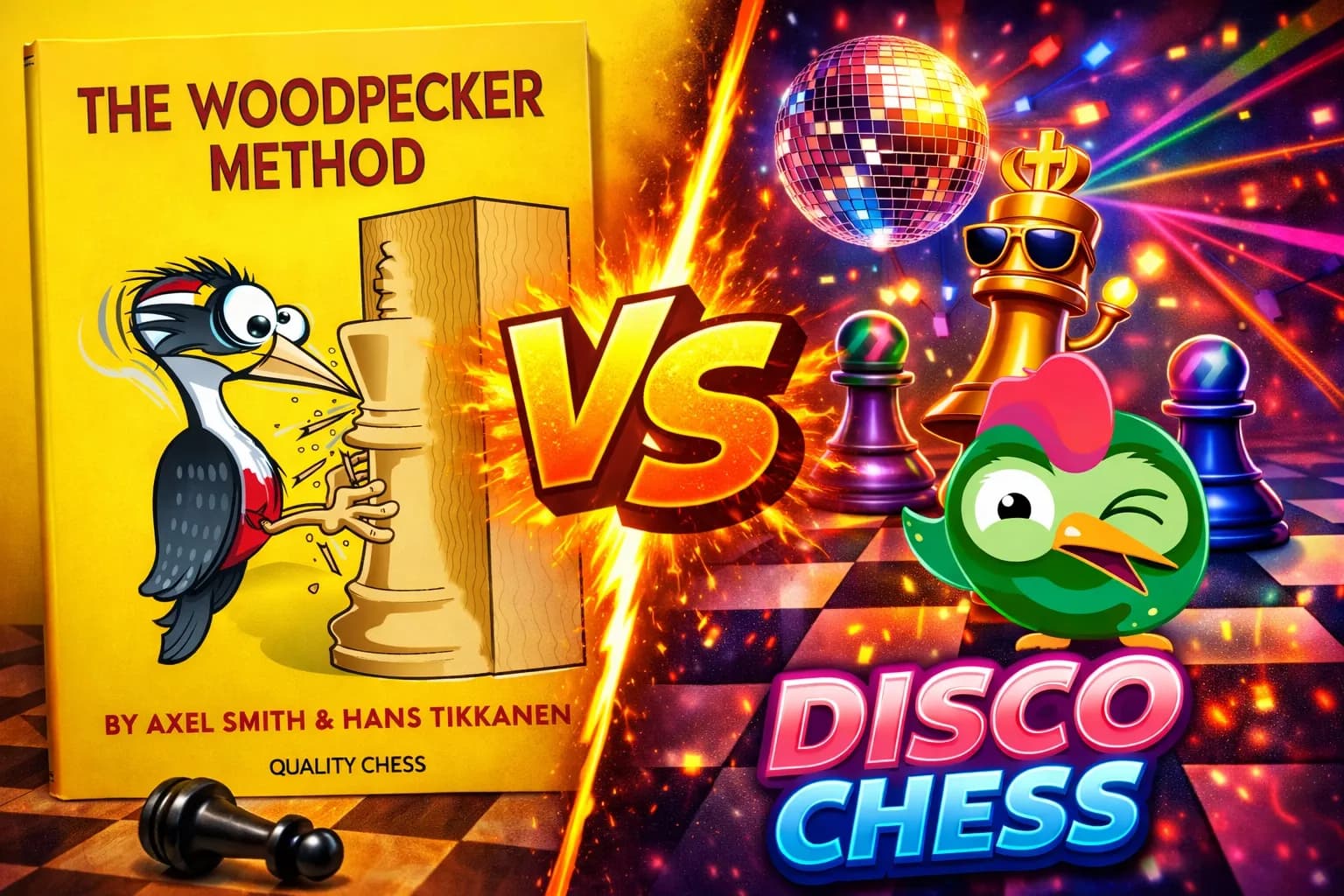
Disco Chess vs The Woodpecker Method Book: Digital vs Analog Training
The book that started it all vs. the app that automates it. What do you gain, and lose, going digital?
TL;DR: The woodpecker method book offers the original 1,128 curated puzzles with full methodology. Disco Chess automates tracking and removes setup friction. Choose the book for the purist experience, or the app for convenience and consistency.
Key Takeaways
- The woodpecker method book by Axel Smith and Hans Tikkanen is the original source with 1,128 carefully curated puzzles.
- Disco Chess digitizes the approach with automatic tracking, timing, and progress analytics.
- The book requires manual setup (board, clock, spreadsheet) but offers tactile engagement and the original curated set.
- Disco Chess removes friction but changes the experience. Solving on-screen isn't identical to board analysis.
- Both are valid: the book for purists who value the original method; the app for convenience and automated tracking.
The Origin Story
In 2018, Grandmaster Axel Smith and International Master Hans Tikkanen published The Woodpecker Method, a chess training book that became an underground sensation among serious improvers.
The premise was radical in its simplicity: instead of solving thousands of different puzzles, solve the same set of 1,128 puzzles seven times in rapid succession. Each cycle faster than the last.
Hans Tikkanen had used this method to achieve three GM norms in just seven weeks. The book promised that readers could replicate his results by following the same disciplined approach.
Disco Chess applies the same principle and extends it to opening training and game-based training from your Lichess games. Same philosophy, broader application.
The woodpecker method is a training system described in the book of the same name by GM Axel Smith and GM Hans Tikkanen, published by Quality Chess. Disco Chess is not affiliated with, endorsed by, or connected to Quality Chess, Chess.com, or Chessable.
What the Book Offers
The Original 1,128 Puzzles
The book contains carefully curated puzzles organized by tactical theme:
- Pins and skewers
- Forks and double attacks
- Discovered attacks
- Back-rank combinations
- Deflection and decoy
- And many more
Each puzzle was hand-selected by titled players for instructive value. This curation matters. Not all puzzles are equally educational.
The Full Methodology Explained
Beyond the puzzles, the book provides:
- The complete theory behind why repetition works
- Detailed instructions on how to time your cycles
- Hans Tikkanen's personal training diary
- Guidance on adapting the method to your level
The Analog Experience
There's something about setting up a physical board, starting a real clock, and working through positions with pieces in hand. Many players report deeper engagement and better retention with physical training.
What About the Chessable Version?
The woodpecker method is also available as a Chessable course with the same 1,128 puzzles as the book, plus video explanations from GM Axel Smith and GM Hans Tikkanen. It uses MoveTrainer's card-based spaced repetition system rather than a cycle-based approach. For a comparison of Chessable's approach vs. Disco Chess, see our Disco Chess vs Chessable article.
What Disco Chess Offers
Automatic Everything
The biggest advantage of Disco Chess is friction removal:
- No setup required. Puzzles are ready instantly
- Automatic timing for every puzzle and every cycle
- Progress tracking without spreadsheets
- Visual analytics showing improvement over time
Flexibility and Accessibility
- Train anywhere: in your browser or with the free iOS and Android apps
- Pause and resume sessions seamlessly
- Multiple puzzle sets to choose from
- No physical materials to carry or maintain
Beyond the Book: Mistake Review, Openings, and Game-Based Training
Disco Chess adds features that the book-based approach can't offer:
- Mistake Review: Puzzles you get wrong enter an Anki-style review queue at increasing intervals (1, 3, 7, 14, 30 days). Learn more about how Mistake Review works.
- Opening Courses: GM-curated courses with video lessons apply the same cycle-based approach to opening repertoires.
- Game-Based Training: Connect your Lichess account and train the tactics you missed in your real games.
Motivation and Feedback
Disco Chess tracks three metrics that directly measure your pattern recognition:
- Accuracy: Are the patterns sticking?
- Solve Time: How automatic is your recognition?
- Efficiency: Your overall improvement multiplier
Plus streak tracking to build consistency. See our detailed explanation of these metrics and what scores to aim for.
The Case for the Book
Purist Appeal
If you want to follow the exact method that produced Hans Tikkanen's results, the book is the source. The puzzles are specifically curated, the methodology is explained in full detail, and you're training the same way the authors did.
Tactile Learning
Research on embodied cognition suggests that physical manipulation of objects can enhance learning and memory. Moving pieces on a real board engages different neural pathways than tapping on a screen.
Focused Attention
No notifications. No temptation to check other apps. When you sit down with a book and board, you're committed to that training session in a way that digital tools sometimes undermine.
Complete Package
The book includes the theory, the puzzles, and the training diary. It's a comprehensive system in one package.
The Case for Disco Chess
Consistency Through Convenience
The best training method is the one you actually do. By removing setup friction, Disco Chess makes it more likely you'll train consistently. A 15-minute session in the iOS or Android app during lunch is better than a planned 1-hour book session you skip because setup feels like too much work.
Accurate Progress Tracking
With the book, you might forget to start your timer, miscount your time, or lose your tracking spreadsheet. Disco Chess logs everything automatically, giving you accurate data on your improvement.
Adaptability
Not everyone wants to commit to 1,128 puzzles. Disco Chess lets you choose puzzle sets of varying sizes and difficulties, adapting the method to your schedule and level.
Modern Conveniences
- Resume interrupted sessions without losing progress
- Access from any browser, or use the free iOS and Android apps with synced progress
- View your training history anytime
- No physical materials to manage
Conclusion
The woodpecker method book is the original source: a complete training system with hand-curated puzzles and detailed methodology from the grandmasters who developed it.
Disco Chess applies the same underlying principle with modern tooling: automatic tracking, timing, and progress analytics.
Choose the book if:
- You value the original, curated puzzle set
- You prefer physical board analysis
- You want the complete methodology explained
- You have discipline to maintain manual tracking
Choose Disco Chess if:
- Convenience is crucial for your consistency
- You want automatic timing and progress tracking
- You prefer training on digital devices
- You want flexibility in puzzle set selection
- You need theme-based training (the book has no theme filtering)
- You need sets for all skill levels (the book has only 3 difficulty levels)
- You want to apply cycle-based repetition training to openings and your own games, not just tactics
Both are valid paths to the same destination: building automatic pattern recognition through disciplined repetition.
| Feature | Disco Chess | The Book |
|---|---|---|
| Setup Time | ~10 seconds to open and start | 5-10 min (board, clock, spreadsheet) |
| Tracking | Automatic, precise timing | Manual (timer + spreadsheet) |
| Puzzle Sets | 170+ sets by theme + level | 1,128 mixed puzzles in 3 levels |
| Theme Training | 18 tactical themes available | No theme filtering |
| Skill Levels | 5 levels (Beginner to Master) | 3 difficulty levels only |
| Learning Depth | Fast on-screen solving | Physical board may aid deeper analysis |
| Portability | Web, plus free iOS and Android apps | Requires book + board + clock |
| Cost | Free (Premium via referrals) | ~$25-30 one-time |
| Best For | Convenience and consistency | Purists and tactile learners |
| Mistake Tracking | Anki-style spaced repetition | Not available |
Frequently Asked Questions
Related articles
The 7 Best ChessBase Alternatives for Mac in 2026
ChessBase is Windows-only and its official Mac guidance dates to 2018. Here are the seven realistic alternatives for Mac users in 2026, fairly compared.
Disco Chess vs ChessTraining.app: Two Free Chess Training Platforms Compared
Both platforms offer woodpecker method training for free. Disco Chess covers tactics, openings, and game-based training; ChessTraining.app adds endgames, visualization, and recall.
Disco Chess vs Chessable: Which Chess Training Platform Is Right for You?
Two chess training platforms compared: Disco Chess uses cycle-based repetition for tactics and openings; Chessable uses MoveTrainer spaced repetition across a massive course library.


 Join our community