
Disco Chess vs ChessTempo: Repetition Training vs Infinite Puzzles
Two different philosophies for chess tactics training: repetition-based mastery vs adaptive variety. Here's how they compare.
TL;DR: Disco Chess builds deep pattern mastery through repetition of curated puzzle sets, plus GM-curated opening courses and game-based training from your Lichess games. ChessTempo builds broad exposure with 2M+ unique puzzles. Choose depth or breadth based on your training goals.
Key Takeaways
- Disco Chess is built on a training system inspired by the woodpecker method: you solve the same puzzle set repeatedly in cycles until patterns become automatic.
- ChessTempo offers a vast database of 2M+ puzzles with adaptive rating, serving fresh problems based on your skill level.
- Disco Chess optimizes for deep pattern recognition through repetition; ChessTempo optimizes for breadth of exposure to new positions.
- Both are free to start, but they serve fundamentally different training philosophies.
- The best choice depends on your goal: mastering specific patterns vs. encountering maximum variety.
Two Different Training Philosophies
The Disco Chess Approach: Depth Through Repetition
Disco Chess is built on a simple premise: you don't learn tactics by seeing a pattern once.
The woodpecker method, which inspired Disco Chess, was developed by GM Axel Smith and used by Hans Tikkanen to earn three GM norms in seven weeks. The method involves solving the same set of puzzles multiple times in rapid cycles. Each cycle, you aim to solve faster and more accurately. Disco Chess offers 170+ puzzle sets organized by tactical theme and difficulty level, plus GM-curated opening courses and game-based training from your Lichess games.
Why does this work? When you see the same tactical motif repeatedly (a back-rank weakness, a knight fork pattern, a discovered attack setup), your brain encodes it more deeply. The pattern moves from "something you can calculate" to "something you recognize instantly."
The ChessTempo Approach: Breadth Through Variety
ChessTempo takes a different approach: expose players to as many different positions as possible.
ChessTempo has been a respected tactics trainer for over 15 years, with a database of over 2 million puzzles known for their quality and instructive value. The platform uses an adaptive rating system to serve problems matched to your current skill level. Solve a puzzle correctly and your rating goes up; fail and it goes down. The system continuously adjusts to keep you in your optimal learning zone.
The theory here is that tactical skill comes from exposure to variety. The more positions you see, the more patterns you'll recognize in real games.
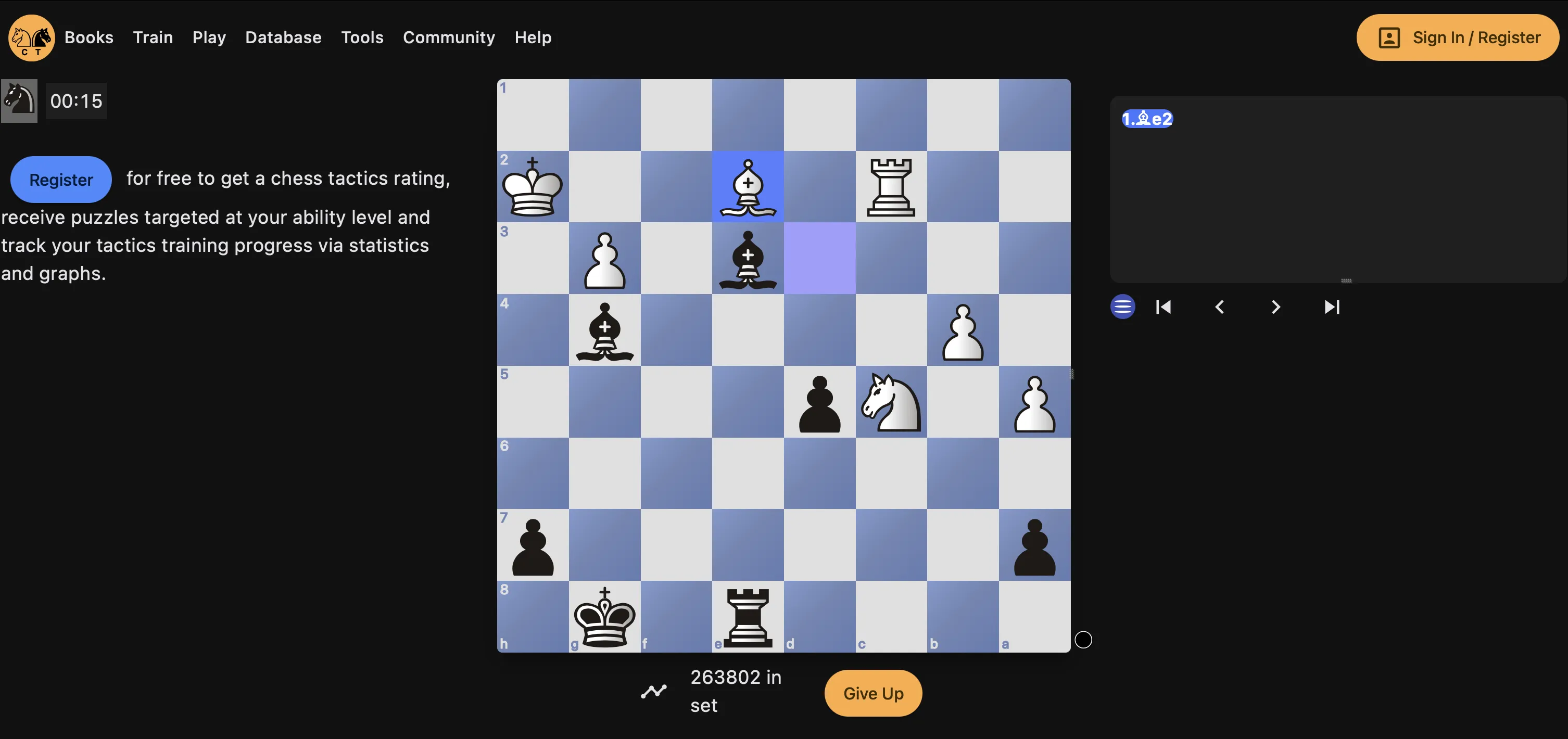 ChessTempo's tactics trainer with adaptive rating system.
Head-to-Head Comparison
Puzzle Selection
Disco Chess:
- You choose a curated puzzle set (500-1000 puzzles)
- Same puzzles repeated across multiple cycles
- Focus on quality and pattern mastery over quantity
ChessTempo:
- Algorithmically selected based on your rating
- Essentially infinite supply of unique puzzles
- Focus on adaptive difficulty and variety
Progress Tracking
Disco Chess tracks three metrics that directly measure pattern recognition:
- Accuracy: Are the patterns sticking?
- Solve Time: How automatic is your recognition?
- Efficiency: Your overall improvement multiplier
See our detailed explanation of these metrics and what scores to aim for.
ChessTempo:
- Tracks your puzzle rating over time
- Provides detailed statistics on performance by motif
- Shows accuracy percentages and time-per-puzzle averages
Training Rhythm
Disco Chess:
- Concentrated sessions: complete a full cycle in one sitting
- Clear milestones: track your cycle count and solve times
- Sessions feel like workouts with measurable progress
ChessTempo:
- Flexible sessions: solve 5 puzzles or 50
- No inherent structure to training
- Easy to fit in anytime, but less direction
The Science Behind Each Approach
Why Repetition Works
Cognitive science research on skill acquisition shows that spaced repetition is one of the most effective learning techniques. By encountering the same patterns multiple times at increasing intervals, you strengthen neural pathways and move knowledge from short-term to long-term memory.
This approach adds an element of speed training. As you repeat cycles, the goal is to solve faster. This trains pattern recognition to be automatic rather than calculated, which is essential for time-pressured games.
Why Variety Works
Exposure to diverse positions has its own benefits. Research on interleaved practice suggests that mixing different problem types can improve transfer to novel situations. If you only train on the same puzzles, you might get very good at those specific patterns but struggle with variations you haven't seen.
ChessTempo's adaptive system also keeps you in the zone of proximal development, always challenged but not overwhelmed.
Who Is Each Tool Best For?
Choose Disco Chess if:
- You believe in deep mastery over surface exposure
- You want structured training with clear cycle-based goals
- You're preparing for time-pressured games where instant recognition matters
- You value seeing measurable improvement in solve times across cycles
- You want completely free access to training
Choose ChessTempo if:
- You want maximum exposure to different positions
- You enjoy rating-based progression and the competitive element
- You prefer flexible, unstructured training sessions
- You want detailed statistics that identify weaknesses by tactical motif
- You value the platform's 15+ year track record and large community
Can You Use Both?
Many players do. A balanced approach might look like:
- Use Disco Chess for dedicated woodpecker-style cycles (e.g., 3x per week)
- Use ChessTempo for casual puzzle solving and variety exposure
- Both approaches have merit: repetition builds automaticity, variety builds adaptability
Conclusion
Both tools represent valid approaches to tactical training, and the research supports each philosophy.
Disco Chess emphasizes depth: solve the same patterns repeatedly until recognition becomes automatic. Beyond tactics, the same cycle-based repetition approach extends to opening courses and game-based training from your Lichess games.
ChessTempo emphasizes breadth: expose yourself to the widest possible variety of positions. With 15+ years of operation and a reputation for high-quality puzzles, it's a trusted resource in the chess community.
The best choice depends on your learning style. Some players thrive with structured repetition; others prefer adaptive variety. Many serious players use both, treating them as complementary rather than competing approaches.
The woodpecker method is a training system described in the book of the same name by GM Axel Smith and GM Hans Tikkanen, published by Quality Chess. Disco Chess is not affiliated with, endorsed by, or connected to Quality Chess, Chess.com, or Chessable.
| Feature | Disco Chess | ChessTempo |
|---|---|---|
| Training Philosophy | Depth through repetition | Breadth through variety |
| Puzzle Selection | 170+ themed sets by level + motif | 2M+ puzzles, algorithmically served |
| Progress Metric | Cycle times, speed improvement | Puzzle rating, accuracy stats |
| Session Structure | Flexible: solve 1 to 500+ puzzles | Flexible: solve 5 or 50 puzzles |
| Difficulty | Choose your puzzle set level | Adaptive rating system |
| Pricing | Free (Premium via referrals) | Free tier + premium membership |
| Platforms | Web, plus free iOS and Android apps | Web, iOS, and Android |
| Best For | Deep mastery of core patterns | Maximum exposure to variety |
| Mistake Tracking | Anki-style spaced repetition | Not available |
Frequently Asked Questions
Related articles
The 7 Best ChessBase Alternatives for Mac in 2026
ChessBase is Windows-only and its official Mac guidance dates to 2018. Here are the seven realistic alternatives for Mac users in 2026, fairly compared.
Disco Chess vs ChessTraining.app: Two Free Chess Training Platforms Compared
Both platforms offer woodpecker method training for free. Disco Chess covers tactics, openings, and game-based training; ChessTraining.app adds endgames, visualization, and recall.
Disco Chess vs Chessable: Which Chess Training Platform Is Right for You?
Two chess training platforms compared: Disco Chess uses cycle-based repetition for tactics and openings; Chessable uses MoveTrainer spaced repetition across a massive course library.


 Join our community